
CAPABILITY / 01
Research compounds
Novel or specialized compounds developed for legitimate research programs with a defined technical objective.
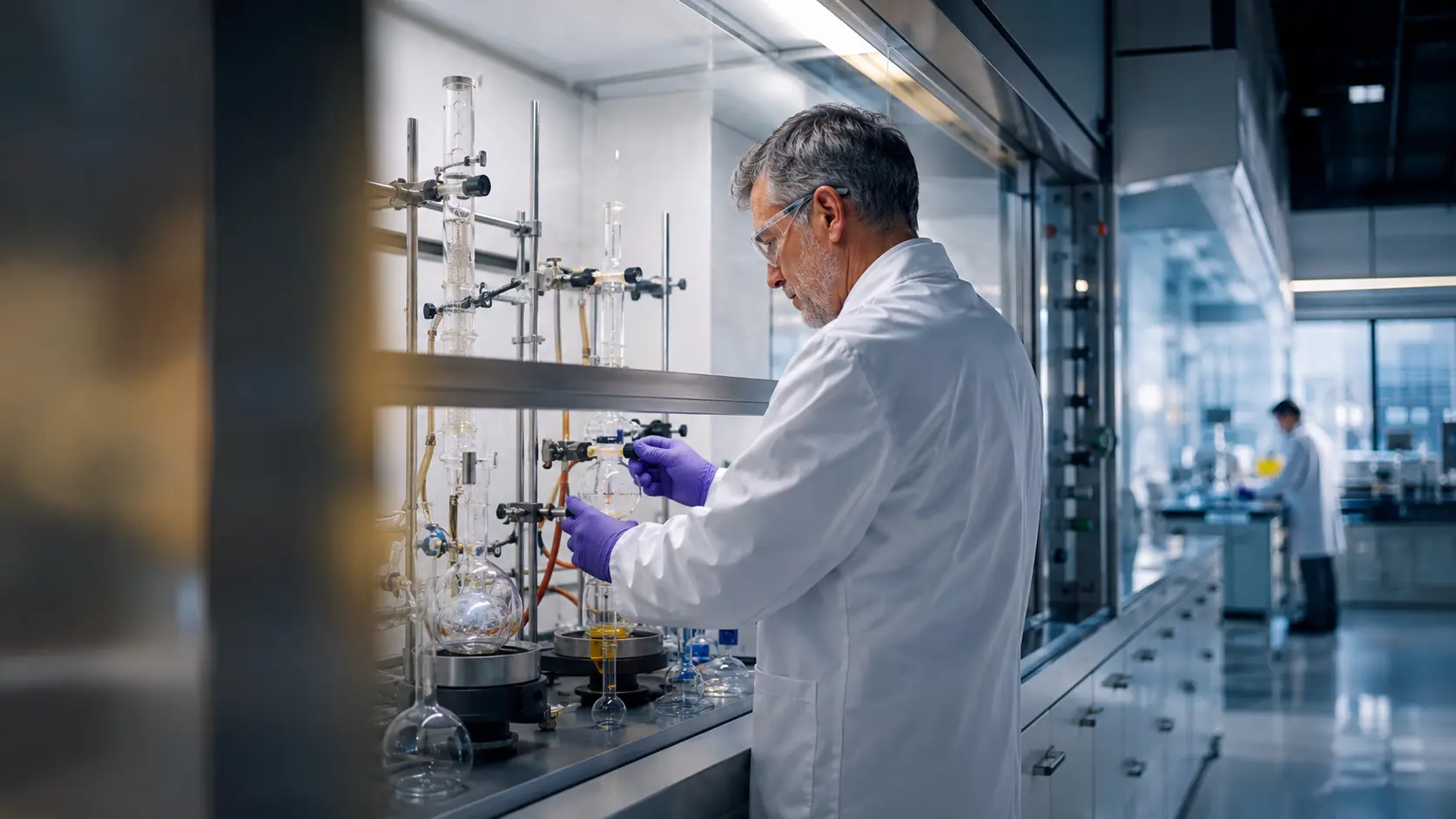
Division A / Custom Synthesis
Custom synthesis support for research compounds, specialty intermediates, feasibility questions, and technically demanding project objectives.
Project focus
Summit’s launch model focuses on custom project review, route development, feasibility, research-use compound support, and qualified execution pathways.
We do not present ourselves as a bulk chemical manufacturer. Every inquiry is screened individually. Scope, capabilities, lawful intended use, handling requirements, analytical expectations, and delivery obligations must be defined before engagement.
Capabilities
CAPABILITY / 01
Novel or specialized compounds developed for legitimate research programs with a defined technical objective.
CAPABILITY / 02
Route-specific intermediates aligned with downstream chemistry, purity, handling, and documentation requirements.
CAPABILITY / 03
Alternative pathway assessment addressing precedent, selectivity, purification, material availability, safety, and practicality.
CAPABILITY / 04
Focused experiments or technical analysis designed to reduce uncertainty before a broader development commitment.
CAPABILITY / 05
Independent review of target strategy, transformations, likely risks, analytical needs, and decision points.
CAPABILITY / 06
Structured assessment of stalled or underperforming routes, based on available records and a clearly defined problem statement.
Project pathway
Each step is proportionate to the accepted scope. Technical findings may require revision to route, schedule, cost, specification, or feasibility.
We collect structure, target specification, quantity, intended use, known history, timeline, and supporting technical records.
The target and constraints are evaluated for technical fit, lawful use, material availability, risk, and documentation needs.
Candidate approaches are compared using literature, scientific judgment, purification strategy, and practical project factors.
Accepted work is defined through deliverables, assumptions, specification, schedule, pricing, responsibilities, and change control.
When execution is accepted and applicable, work proceeds under the defined project plan with controlled records and technical communication.
Results and records are assembled according to scope. Material delivery occurs only when expressly included, feasible, lawful, and accepted.
Documentation & confidentiality
Documentation may include project scope, route assessments, material identity records, controlled laboratory notes, observations, analytical context, deviations, summaries, and COA support when specified. Exact deliverables are established in the proposal.
Confidential customer information is handled on a need-to-know basis. Where an NDA or separate confidentiality agreement is required, it should be executed before sensitive information is transmitted. Submitting an online inquiry alone does not create an NDA.
Responsible-use commitmentMaterials and services are intended for lawful research, analytical, industrial, or laboratory use only.
Confidential initial review
Provide the available technical details, intended use, quantity, specification, and target timeline.